Preventing Logistics Stagnation with Limited Resources: Why Digital Payment is Essential for SMEs
Insights
April 10, 2026
The Japanese B2B payment market is estimated to exceed 1,000 trillion yen annually, yet "bank transfer" remains its primary method. In the 24/7 world of logistics, operations tied strictly to bank hours are often a silent hurdle to smooth progress. ONE Finance was designed to change this—enhancing your company’s agility by streamlining payments and improving cash flow.
Switching to card payments ensures that your logistics never pause, creating the "breathing room" your business deserves.
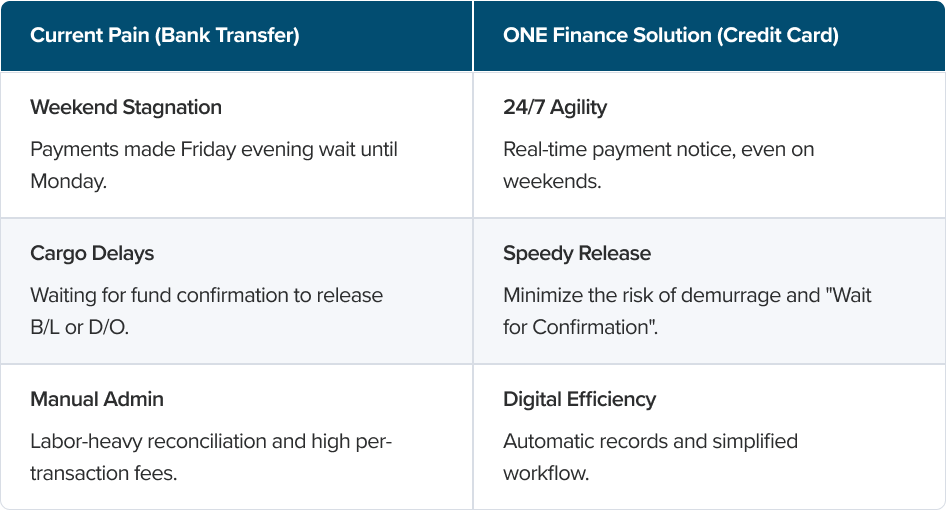
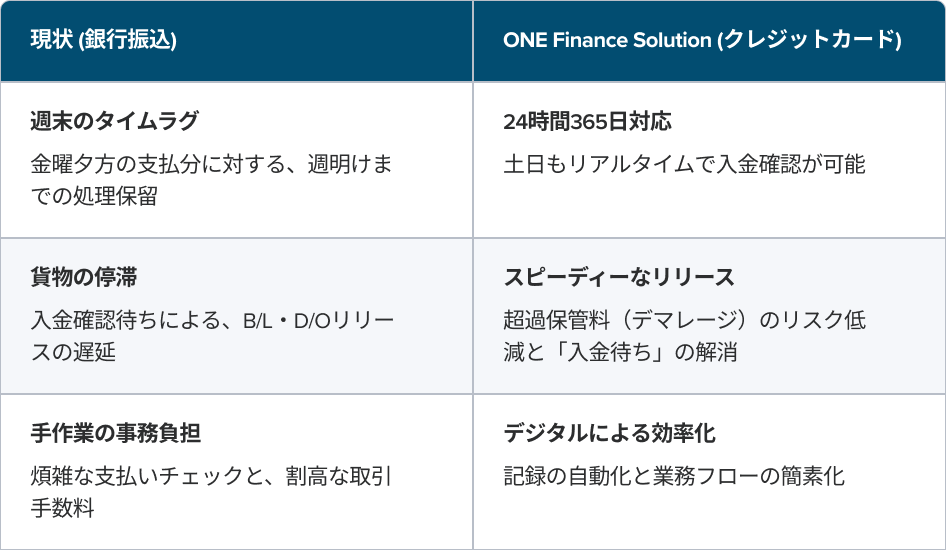
Operational Efficiency Comparison between Bank Transfer and ONE Finance
Source: ONE DEJIMA
Insight 1:
Creating "Breathing Room" in Your Cash Flow
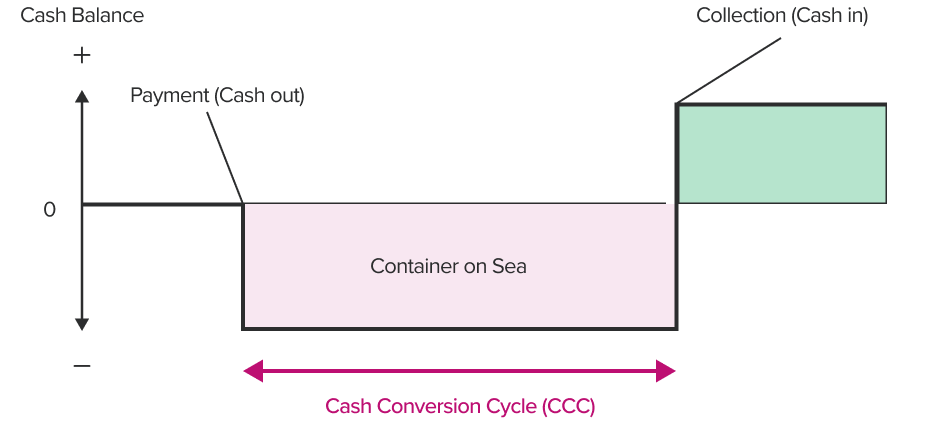
In the import/export business, how you manage the "time gap" between paying costs and collecting revenue is a critical theme that dictates the agility of your operations.
1. A Countermeasure to the Global Slowdown in Capital Efficiency
According to a survey by J.P. Morgan, even global corporations with sophisticated financial management saw their Cash Conversion Cycle (CCC) worsen by an average of 2.4 days in 2023. For SMEs with limited financing options, maintaining full control over "when and where to place your cash" could be the key to building a resilient business. By using credit card payments to effectively defer your payment window by approximately 30 to 60 days, it becomes possible to balance your cycles of income and expenditure. This shift can generate much-needed "temporal breathing room" in your daily cash flow management.
Cash Conversion Cycle (CCC)
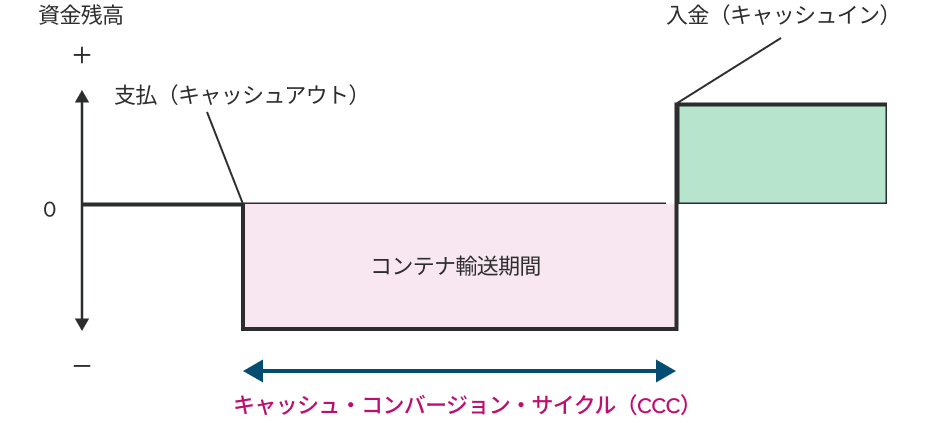
Source: ONE DEJIMA
2. Preparing for an Uncertain Logistics Environment
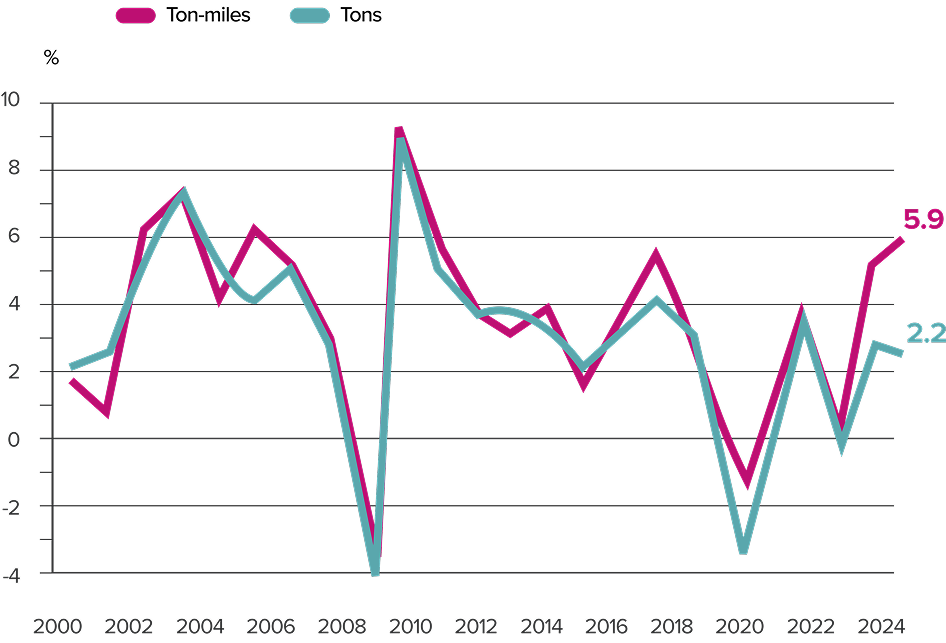
According to UNCTAD (United Nations Conference on Trade and Development), transport distances surged by +5.9% in 2024. As shipping routes become longer and capital is increasingly prone to being "stuck" in transit, having "payment flexibility"—the ability to control your own cash outflows—serves as a reliable support system in today’s uncertain market.
Growth in maritime trade, tons and ton-miles, annual percentage change, 2001–2024
3. Key Takeaways
- While global companies saw cash efficiency decline by an average of 2.4 days, having the tools to control cash allocation can be a significant support for the business foundations of SMEs.
- By extending payment terms by 30 to 60 days through card payments, it is possible to balance inflow and outflow cycles and create much-needed "time for breathing room" in your cash flow.
Insight 2:
Bridging the Time Gap between Logistics and Payments
International logistics never stop, yet payments that depend on bank operating hours create a slight time lag between the movement of goods and the movement of funds. Eliminating this stagnation of "even a few hours or a single day" could be exactly what significantly changes the view from your front lines.
1. Export: Eliminating the "Wait for Confirmation" in B/L Issuance
In export operations, confirming the receipt of freight payments is generally a prerequisite for releasing a Bill of Lading (B/L). With traditional bank transfers, a remittance made on a Friday evening is often processed as a "Monday (next business day) transaction," which can cause procedures to grind to a halt over the weekend. By using real-time credit card payments, however, notice of payment completion can be shared instantly—even at night or over the weekend—allowing you to avoid delays caused by waiting for confirmation of funds. This represents a vital step toward reducing trade lead times, a goal that has also been highlighted as a national-level challenge.
2. Import: Proper Cargo Pickup and Cost Management
In import operations, the process of confirming payment is also crucial for the issuance of a D/O (Delivery Order), which is required to pick up cargo. If a time lag occurs in confirming funds via bank transfer, it increases the risk of exceeding the "free time" (the complimentary storage period) at the port, leading to potential demurrage (excess storage fees) or detention (container return delay fees). In fact, a study by Container Change reports that these costs at major ports can reach an average of several hundred US dollars per day in some cases. Digitalizing your payments and preparing for pickup without waiting for bank operating hours can serve as a helpful way to curb such additional costs and improve the overall turnover of your logistics operations.
Top 10 most expensive ports in terms of DD charges
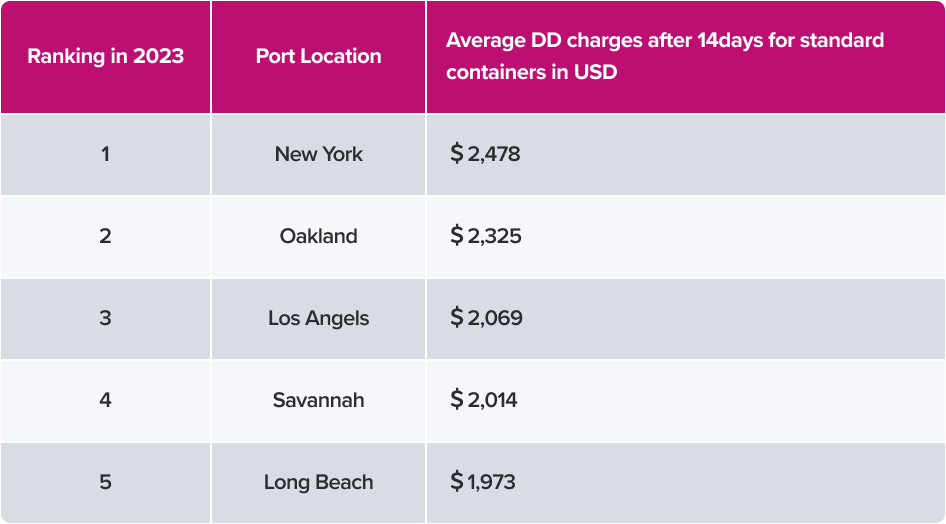
Source: Container xChang. (2024). Demurrage and detention charges: Save money in top 10
3. Key Takeaways
- In the 24/7 world of international logistics, payments that are not restricted by bank hours can be the key to clearing bottlenecks on the ground.
- By eliminating weekend and nighttime waits for payment confirmation through real-time settlement, this approach contributes to avoiding export delays and shortening overall trade lead times.
- Payments that are independent of bank hours help speed up D/O issuance, supporting the avoidance of demurrage charges and improving the efficiency of import cargo pickup.
Insight 3:
Optimizing Administrative Flow to Focus on Your Core Business
The administrative-heavy procedures required for every remittance can act as a "constraint," taking away precious time from the "future-focused work" you should truly be concentrating on.
1. Reducing Administrative Burden and Fees
The repetitive tasks of processing individual bank transfers and reconciling them with invoices can become a constant burden for your staff. Furthermore, the bank fees incurred with each transaction can be a factor that puts pressure on your profit margins. 6 By consolidating these payments through credit card transactions, your administrative workflow becomes remarkably simple, leading to greater operational transparency—making it easier to track exactly when, for what, and how much was paid. Moreover, rather than being rushed by urgent remittance demands, having the option of credit card payment serves as an effective adjustment tool to create a certain sense of "breathing room" in your daily cash management.
2. Streamlining Compliance through Digitalization
Introducing credit card payments establishes a system where data is recorded the moment a payment is made, keeping the operational workflow moving without interruption. This also makes complying with the Invoice System and the Amended Electronic Book Preservation Act smooth. Since your daily payments automatically become digital records 7 , you can transition naturally to a digital management style within your routine operations—without the need for significant system investments. This shift could be the very catalyst that transforms your administration from a "processing center" into an efficient hub that strategically supports the flow of both logistics and capital.
3. Key Takeaways
- Consolidating payments onto cards simplifies administrative processes and enhances operational transparency, leading to cash management with "breathing room" that is free from the pressure of urgent remittance tasks.
- Automatic data recording at the time of payment enables a smooth transition to the Electronic Preservation Act and the Invoice System, helping to streamline administrative departments without major investments and creating an environment where you can focus on work that truly generates value.
You might feel that "Transitioning to a new system seems like a lot of work," but there is no need to overhaul your current operations. By keeping your long-cherished business practices intact and simply replacing the single touchpoint of "payment" with a digital solution, this small step can significantly streamline fund confirmations and create much-needed "breathing room" in your payment cycle.
The days of accepting "Waiting for bank hours is just the way it is" can be a thing of the past. With just one small shift in your perspective, you can free yourself to focus on the "value-driven work" that truly deserves your passion. We have prepared a one-minute video that illustrates how this solution works in practice. Please take a moment to see for yourself how this "small shift" can transform the landscape of your daily operations. Now is the time to take the first step toward expanding your "operational margins" and embrace this change with ONE Finance.
Data Sources:
[1] Source: Kikushige, T. (2024). DX in the B2B Payment Market Will Accelerate Productivity Gains for Japanese Companies. NTT Data Institute of Management Consulting, Inc. (accessed. Feb 16. 2026)
[2] Source: SB Payment Service. (2025). Survey on B2B Payment and Procurement Status Among Corporations. (accessed. Feb 16. 2026)
[3] Source: J.P. Morgan. (2024). Increasing efficiency: Working Capital Index 2024 (accessed.Mar 03. 2026)
[4] Source: Boston Consulting Group (2024). Avoid the Hidden Costs of Extending Supplier Payment Terms (accessed.Feb 16. 2026)
[5] Source: 経済産業省. (2024). 貿易プラットフォームの利活用推進に向けた検討会中間報告書. (accessed. Mar 03. 2026)
[6] Source: Bank of Japan. (2024). Payment and Settlement Systems Report. (accessed. Feb 18. 2026)
[7] Source: Money Forward, Inc. (2025). How to Use Credit Cards with Money Forward to Comply with the Revised Electronic Book Storage Act. (accessed. Feb 27. 2026)